Decoding Canadian Appliance Energy Ratings: A Practical Guide
When shopping for new appliances, you have probably noticed labels and certifications that seem cryptic and overwhelming. In Canada, appliance energy ratings systems are designed to help consumers understand how much electricity appliances use and their long-term operating costs. Vancouver residents shopping for refrigerators, washing machines, dryers, and other major appliances often do not fully understand what these ratings mean or how to use them to make cost-effective decisions that maximize savings.
Understanding appliance energy ratings is crucial for making smart purchasing choices. The right rating system helps you compare models, estimate annual electricity costs, and even qualify for rebates that reduce upfront expenses. Let us break down how these systems work so you can make informed decisions when replacing appliances in your home.
The average appliance operates for 10-15 years, meaning your purchasing decision will impact your electricity bills for a decade or more. Understanding energy ratings helps you make decisions that save thousands of dollars over the appliance’s lifetime. This is one of the most important purchasing decisions for homeowners.
EnerGuide Labels: Canada’s Standard Energy Information
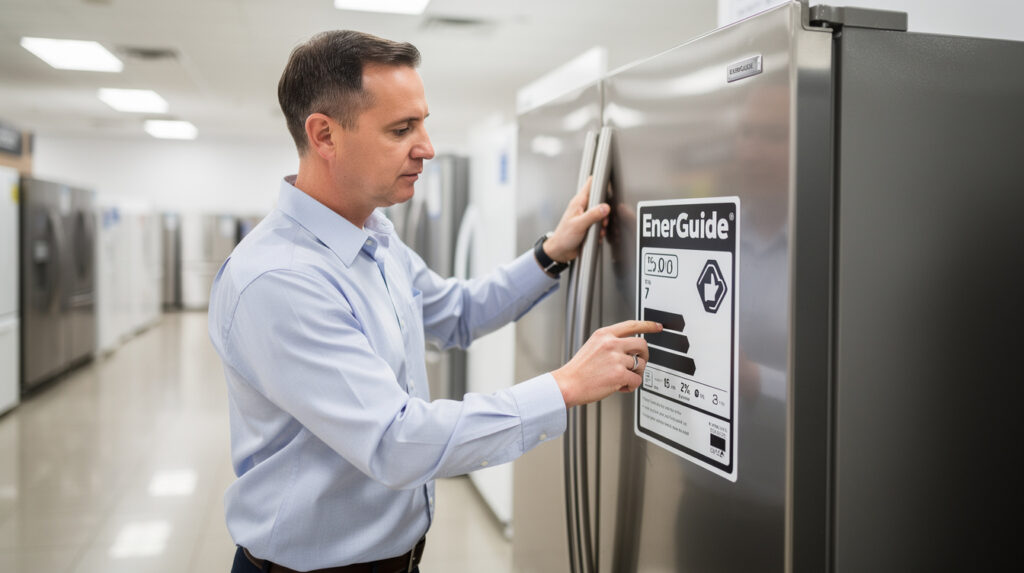
Every major appliance sold in Canada displays an EnerGuide label. This standardized label provides specific energy consumption information in a format that makes comparison easier across different brands and models. The label is regulated by Natural Resources Canada.
What Information Is on an EnerGuide Label
The EnerGuide label includes several key pieces of information:
- Energy consumption estimate: Measured in kilowatt-hours (kWh) per year or per cycle for specific appliances
- Annual operating cost: Based on average Canadian electricity prices (usually updated annually)
- Comparison bar: Shows how the model compares to other similar models in its class
- Model specification: Details like capacity for refrigerators or load size for washers
- Energy efficiency rating: A letter grade from A to G, with A being most efficient
The comparison bar is particularly useful. It shows where this specific model falls on the spectrum of energy use compared to all similar appliances. A model on the left side of the bar uses less energy than average; a model on the right uses more.
Reading the Annual Operating Cost
The annual operating cost shown on the EnerGuide label is crucial for comparing true lifetime costs. For example, two refrigerators might differ by $100 in purchase price, but if one costs $50 more annually to operate, that savings difference reverses within 2-3 years of ownership.
Remember that EnerGuide costs are based on average Canadian electricity rates. In Vancouver, BC Hydro rates vary slightly, so your actual costs might be slightly different. However, the relative comparison between models remains valid even with local rate variations.
ENERGY STAR Certification: Beyond Basic Standards
While EnerGuide labels are required on all major appliances, ENERGY STAR certification is optional and indicates that an appliance exceeds minimum efficiency standards. In Canada, ENERGY STAR is administered by Natural Resources Canada with rigorous testing standards.
What ENERGY STAR Means
An ENERGY STAR certified appliance must be among the top 15-30 percent most efficient models in its category, depending on the appliance type. This certification requires rigorous testing and verification. If an appliance displays the ENERGY STAR logo, you can trust that it is genuinely more efficient than average.
Financial Benefits of ENERGY STAR Appliances
- Lower annual operating costs: ENERGY STAR appliances typically use 20-40 percent less energy than standard models
- Federal rebates: Natural Resources Canada and provincial utilities often offer rebates for ENERGY STAR appliances
- BC Hydro rebates: British Columbia residents frequently qualify for additional rebates (current programs vary, but typically 50-300 dollars depending on appliance type)
- Long-term savings: Over a 15-year appliance lifespan, an ENERGY STAR refrigerator might save 2000 dollars or more in electricity costs compared to a standard model
For Vancouver residents, checking BC Hydro’s current rebate programs before purchasing is essential. These rebates can make ENERGY STAR appliances affordable despite higher upfront costs. Many retailers have partnerships with BC Hydro to apply rebates automatically.
How to Read and Compare Appliance Energy Labels
Comparing appliance energy ratings requires understanding what factors affect consumption and how different label types communicate this information. This skill directly impacts your long-term savings.
Key Factors Affecting Energy Use
Several variables influence how much energy an appliance consumes:
- Capacity: Larger capacity appliances typically use more energy, though efficient larger models may use less than inefficient smaller ones
- Type: Front-load washers use less water and energy than top-load washers; chest freezers are more efficient than upright models
- Age: Appliances older than 10-15 years are dramatically less efficient than current models
- Features: More features sometimes increase energy use; smart features sometimes decrease it
- Climate control: In Vancouver’s cooler climate, refrigerators and air conditioners use less energy than in warmer regions
Comparison Strategy for Similar Models
When comparing multiple appliances:
- Focus on EnerGuide cost first: The annual operating cost is the most important number for budget impact
- Check the comparison bar: Position on the bar shows relative efficiency better than absolute numbers
- Consider capacity differences: A larger model might use slightly more energy but offer better value
- Factor in ENERGY STAR status: If both models are similar, choose the ENERGY STAR certified option
- Calculate total cost of ownership: Add purchase price plus (annual operating cost multiplied by expected years of ownership)
Example: Model A costs 1200 dollars and uses 120 dollars per year in electricity. Model B costs 1500 dollars and uses 75 dollars per year. Model B’s higher cost is recouped after 4 years, and by year 10, you have saved 750 dollars with Model B. Total cost of ownership clearly favors the higher-efficiency model in most cases.
Appliance-Specific Energy Rating Information
Different appliance types have specific energy rating characteristics worth understanding for accurate comparison.
Refrigerators and Freezers
Refrigerator energy use has improved dramatically in recent years. Modern ENERGY STAR refrigerators use about 50 percent less energy than 1990s models. Key factors affecting consumption:
- French-door models use slightly more energy than side-by-side
- Through-the-door ice and water dispensers increase energy use by 10-20 percent
- Dedicated ice makers use more energy than freezer-compartment ice makers
- Frost-free models use more energy than manual-defrost (though manual defrost is impractical for most people)
For Vancouver residents, an ENERGY STAR refrigerator typically uses 400-600 kWh annually compared to 800-1200 kWh for older standard models. This translates to annual savings of 30-50 dollars or more depending on BC Hydro rates.
Washing Machines
Washing machine energy ratings vary dramatically based on type. Front-load washers are significantly more efficient than top-load models:
- Front-load ENERGY STAR: 100-150 kWh per year
- Top-load ENERGY STAR: 150-200 kWh per year
- Standard top-load: 300-400 kWh per year
Front-loaders also use less water and less detergent, providing additional savings beyond just electricity. The higher upfront cost of front-loaders is often recouped through water and electricity savings within 5-7 years.
Dryers
Dryer energy ratings distinguish between vented and heat pump models. Heat pump dryers are significantly more efficient but cost more:
- Standard vented dryer: 300-500 kWh per year
- ENERGY STAR vented dryer: 250-350 kWh per year
- Heat pump dryer: 150-200 kWh per year
Heat pump dryers cost 1500-2500 dollars versus 400-900 dollars for standard models, but their energy efficiency is superior and they are gentler on clothes.
Dishwashers
Modern dishwashers are surprisingly efficient, using less water and energy than hand-washing. Energy ratings for dishwashers measure energy use per cycle:
- Standard dishwasher: 150-250 kWh per year (accounting for typical use)
- ENERGY STAR dishwasher: 100-150 kWh per year
Interestingly, running the dishwasher is often more efficient than hand-washing, so ENERGY STAR certification here benefits both your wallet and the environment.
Calculating Annual and Lifetime Energy Costs
Understanding how to calculate actual energy costs helps with purchase decisions and justifies upfront expenses.
Basic Calculation Method
Step 1: Find the annual kWh on the EnerGuide label
Step 2: Multiply kWh by your local electricity rate (check BC Hydro’s current rates)
Step 3: This is your annual operating cost
Example: An appliance uses 400 kWh annually. BC Hydro’s residential rate is approximately 0.16 dollars per kWh. Annual cost = 400 x 0.16 = 64 dollars.
Lifetime Cost Calculation
To compare models over their full lifespan:
Total ownership cost = Purchase price + (Annual operating cost x Years of expected use)
Example: Model A costs 1000 dollars and uses 100 dollars per year. Model B costs 1500 dollars and uses 50 dollars per year. Expected lifespan is 15 years.
- Model A: 1000 dollars + (100 dollars x 15) = 2500 dollars total
- Model B: 1500 dollars + (50 dollars x 15) = 2250 dollars total
Model B costs 250 dollars less over its lifetime despite higher purchase price. This calculation reveals why more efficient models often provide better total value.
BC Hydro Rebates and Incentives for Energy-Efficient Appliances
British Columbia offers various rebate programs encouraging purchase of efficient appliances. These programs change annually, so always check current offerings before purchasing.
Typical BC Hydro Rebate Categories
Historically, BC Hydro has offered rebates for:
- ENERGY STAR refrigerators: 50-100 dollars
- ENERGY STAR washer or dryer combinations: 50-200 dollars
- Heat pump dryers: 100-300 dollars (varies by model)
- Induction cooktops: 25-50 dollars
Rebate amounts and eligible models change, so visit BC Hydro’s website or contact them before making purchase decisions. Some retailers automatically apply rebates at purchase; others require mail-in rebate applications.
How to Qualify for Rebates
- Verify the appliance is ENERGY STAR certified (or eligible product type)
- Check that your model is on the current eligible list
- Keep purchase receipt and proof of purchase
- Submit rebate application within specified timeframe (typically 60-90 days)
- Provide required documentation (serial numbers, purchase dates, etc.)
Comparing Most Efficient Appliance Types
If you are shopping for new appliances and budget allows, prioritize these replacements for maximum energy savings:
Best ROI for Energy-Efficient Replacements
- Number One Priority: Refrigerator – Runs 24/7, dramatic efficiency improvements since older models
- Number Two Priority: Washing Machine – Especially upgrading to front-load; saves water and energy
- Number Three Priority: Water Heater – Replacing old water heaters with tankless or heat pump models provides huge savings
- Number Four Priority: Dryer – Heat pump dryers are expensive but extremely efficient
These appliances run frequently and for many hours, so efficiency improvements have the largest financial impact on your utility bills.
Understanding Energy Rating Limitations
While energy ratings are helpful, they have limitations worth understanding for realistic expectations.
What Energy Ratings Do Not Tell You
- Durability: More efficient does not necessarily mean longer-lasting
- Reliability: Energy efficiency rating does not indicate warranty length or repair frequency
- Performance quality: An inefficient washer might clean better than an efficient one
- Features: Additional convenient features might justify higher energy use
- Climate differences: Vancouver’s mild climate differs from other regions, affecting actual energy use
Use energy ratings as one factor among many when making purchase decisions. Combine ratings with reliability research and product reviews for comprehensive evaluation.
Making Your Appliance Purchase Decision
Here is a complete decision framework combining energy ratings with other factors:
Purchase Decision Checklist
- Research reliability ratings and warranty length
- Compare EnerGuide energy costs across 3-5 models
- Check ENERGY STAR status
- Calculate total ownership cost including energy
- Verify BC Hydro rebate eligibility
- Read reviews about performance and durability
- Consider actual features you need versus want
- Factor in installation costs and old appliance disposal
When to Seek Professional Advice
If you are comparing complex appliance options or uncertain about energy implications, Tech Angels technicians in Vancouver can help. We understand local electricity costs, BC Hydro rebate programs, and can advise whether repairing your current appliance or replacing it makes financial sense.
We serve all of Vancouver and surrounding areas, helping families make smart appliance decisions based on their specific needs and energy costs. Contact Tech Angels for professional guidance on whether your current appliance should be repaired or replaced, and which energy-efficient models offer the best value for your household.
Local Vancouver Considerations for Energy Ratings
Vancouver residents have unique circumstances affecting appliance energy use. Our mild climate means refrigerators and air conditioners use significantly less energy than in other Canadian regions. However, our humid coastal climate means dehumidifying appliances may work harder. Understanding these local factors helps you interpret energy ratings accurately for your specific situation. Contact Tech Angels for local expertise on appliance selection and energy efficiency.
Related Articles
Explore more appliance care tips from the Tech Angels blog: