The Hidden Reason Your Dishes Are Not Getting Clean
You load the dishwasher, add the detergent, run a full cycle, and open the door expecting sparkling dishes. Instead, you find food residue clinging to plates, cloudy glasses, and utensils that are clearly not clean. Before you blame the detergent, the water temperature, or the dishwasher itself, there is a component you should check first: the spray arms.
Dishwasher spray arms are the workhorses of the cleaning process, and when they are not functioning properly, nothing else matters. Clogged, damaged, or worn spray arms are one of the most common causes of poor dishwasher performance, and the good news is that they are relatively easy to inspect, clean, and replace when necessary.
In this guide, we will explain how spray arms work, what causes them to malfunction, how to recognize the warning signs, and what you can do to get your dishwasher back to peak performance.
How Dishwasher Spray Arms Work
Understanding the spray arm system helps you appreciate why they are so important and what happens when they fail.
The Basic Mechanism
Your dishwasher typically has two or three spray arms: one at the bottom of the tub below the lower rack, one in the middle between the upper and lower racks (often attached to the center post or the upper rack assembly), and sometimes one at the top of the tub that cleans the upper rack from above.
During a wash cycle, the dishwasher’s circulation pump pushes hot water through the spray arms under pressure. The water exits through small holes or jets spaced along the arms, creating a spinning pattern that reaches every dish, glass, and utensil in the machine. The arms spin because the water jets are angled, creating a natural rotational force as the water exits. There is no motor driving the spin; it is purely the water pressure and jet angle that makes them rotate.
Why Rotation Matters
The spinning motion is critical. A spray arm that is not rotating freely cannot distribute water evenly across all the dishes. Some areas will get blasted with water while others receive little or none. This is why you might find some dishes perfectly clean and others barely touched after a cycle. The rotation ensures that every position in the dishwasher receives equal water coverage throughout the wash and rinse cycles.
Signs Your Dishwasher Spray Arms Need Attention
Here are the tell-tale signs that your spray arms are not performing as they should.
Food Residue Left on Dishes
This is the most obvious sign. If you are consistently finding food particles, grease, or residue on dishes after a complete wash cycle, the spray arms are a prime suspect. Pay attention to patterns: if the dirty dishes are always in the same area of the dishwasher (for example, always on the upper rack or always in the corners), that points to a specific spray arm that is not reaching those areas due to clogged jets or restricted rotation.
Cloudy or Spotty Glasses
While mineral deposits from hard water can cause spotting, consistently cloudy glasses can also indicate that the spray arms are not delivering enough water pressure or coverage during the rinse cycle. If the rinse water does not reach all surfaces of the glassware, detergent residue and food particles remain and dry onto the surface.
Dishes in Certain Areas Always Dirty
If you notice that dishes in specific rack positions are consistently dirtier than others, it is a strong indicator that the spray arm serving that area has partially or fully clogged jets. The blocked holes create dead zones where water flow is reduced or eliminated.
Visible Debris in Spray Arm Holes
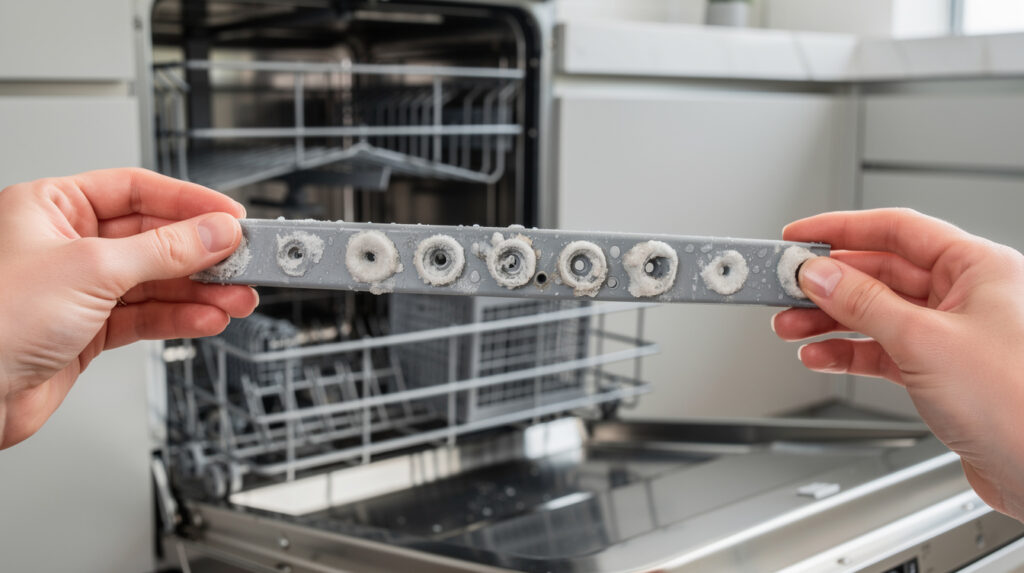
Take a moment to look at the spray arm holes directly. You may be able to see food particles, mineral deposits, or other debris visibly blocking the openings. White or off-white crusty buildup around the holes is a sign of mineral deposits from hard water. Small bits of food, seeds, or grains lodged in the holes indicate that the dishwasher filter may also need cleaning.
Spray Arms Not Spinning Freely
With the dishwasher empty, you can manually spin the spray arms by hand. They should rotate freely and smoothly. If a spray arm feels stiff, grinds, catches, or wobbles excessively, the bearings or mounting hardware may be worn, or debris may be interfering with the rotation.
Unusual Noises During the Cycle
A spray arm that is obstructed by a dish, utensil, or piece of broken plastic can make a clicking, thumping, or knocking sound as it tries to rotate and hits the obstruction. If you hear rhythmic noises during the wash cycle that you have not noticed before, check whether anything is interfering with the spray arm movement.
Water Pooling or Not Draining Properly
While drainage issues are usually related to the drain pump or filter, severely clogged spray arms can affect water circulation patterns in the tub, occasionally contributing to poor drainage. If you are experiencing multiple symptoms, including drainage issues, the spray arms should be part of your troubleshooting process.
What Causes Spray Arm Problems
Understanding the root causes helps you prevent problems from recurring after you have cleaned or replaced the spray arms.
Mineral Buildup from Hard Water
Hard water is the single biggest enemy of dishwasher spray arms. Minerals like calcium and magnesium in hard water gradually accumulate inside the spray arms and around the jet holes. Over time, this buildup narrows the openings and reduces water flow. In areas with particularly hard water, mineral deposits can almost completely seal some holes shut.
Vancouver’s water is generally considered soft compared to many other Canadian cities, thanks to the mountain reservoir sources. However, mineral content can vary by neighborhood and especially in areas that draw from different water systems. Even moderately soft water will cause some mineral buildup over time, so periodic cleaning is still necessary.
Food Particle Blockages
Small food particles that make it past the dishwasher’s filter system can lodge in spray arm holes. Seeds, grains of rice, small bits of label or packaging material, and broken glass fragments are common culprits. This is why it is important to scrape (not necessarily pre-rinse) dishes before loading and to keep the dishwasher filter clean.
Wear and Deterioration
Spray arms are typically made of plastic, and over years of exposure to hot water, detergent, and constant spinning, the plastic can become brittle, warp, or crack. Metal spray arms (found in some higher-end models) are more durable but can still corrode over time. Worn bearings and mounting hardware can also cause the spray arms to wobble, sit at the wrong angle, or fail to spin properly.
Loading Interference
Tall items, improperly loaded utensils, or dishes that extend beyond the rack boundaries can physically block the spray arm from rotating. This is not a spray arm defect but rather a loading issue, and it is one of the most common reasons for poor cleaning performance. Always make sure the spray arms can rotate freely after loading the dishwasher. Give them a spin by hand as a quick check before starting the cycle.
How to Clean Your Dishwasher Spray Arms
Cleaning your spray arms is a straightforward process that should be done every three to six months, or more frequently if you have hard water or notice reduced cleaning performance.
Step 1: Remove the Spray Arms
Most spray arms are designed for easy removal. The lower spray arm typically twists off counterclockwise or has a clip or nut that holds it in place. The upper spray arm may attach to the upper rack assembly or to a center post. Consult your dishwasher’s manual for specific instructions, as the removal method varies by model. In most cases, no tools are required.
Step 2: Rinse Under Running Water
Hold the spray arm under warm running water and let it flow through the center opening and out through the holes. This will flush out loose debris and give you a sense of how many holes are flowing freely versus blocked.
Step 3: Clear the Holes
Use a toothpick, wooden skewer, or thin wire to carefully clear each hole in the spray arm. Insert the pick into each hole and wiggle it gently to dislodge any food particles or mineral deposits. Work your way around the entire spray arm, clearing every hole. Avoid using metal tools that could enlarge the holes, as this would reduce water pressure.
Step 4: Soak in Vinegar
For mineral buildup that a toothpick cannot remove, soak the spray arms in white vinegar. Place them in a basin or sink filled with enough warm water and white vinegar (a fifty-fifty mix) to fully submerge them. Let them soak for at least two hours, or overnight for heavy buildup. The acidity of the vinegar dissolves mineral deposits without damaging the plastic or metal of the spray arms.
Step 5: Scrub and Rinse
After soaking, use an old toothbrush to scrub the exterior of the spray arms, paying special attention to the area around each hole. Rinse thoroughly under running water and use the toothpick again to clear any loosened deposits from the holes.
Step 6: Check Rotation
Before reinstalling, hold the spray arm by its center and spin it. It should rotate smoothly. If it feels rough or gritty, the bearing area may have buildup too. Clean the center hub and the mounting post on the dishwasher with a vinegar-dampened cloth.
Step 7: Reinstall
Reattach the spray arms, making sure they are secure but not overtightened. Spin each one by hand to verify free rotation with no obstructions from the racks or the tub.
When Cleaning Is Not Enough: Signs You Need Replacement
Cleaning resolves the majority of spray arm issues, but there are situations where replacement is the better option.
Cracks or Warping
If the spray arm is cracked, split, or visibly warped, it needs to be replaced. Cracks allow water to escape before reaching the jet holes, reducing pressure and coverage. Warping can cause the arm to hit the racks or tub during rotation.
Holes That Are Permanently Enlarged
Over time or due to aggressive cleaning, the jet holes can become enlarged. Larger holes mean lower water pressure at each opening, which reduces cleaning effectiveness. If you notice that the holes appear significantly larger than they were originally, a new spray arm will restore proper water pressure and spray pattern.
Worn Bearings or Hub
If the spray arm wobbles excessively on its mounting post or if the center hub is cracked or worn, the arm will not sit at the correct angle and may not spin properly. Replacement spray arms include new bearing surfaces, so installing a new one resolves the issue.
Persistent Poor Performance After Cleaning
If you have thoroughly cleaned the spray arms and they still are not delivering adequate cleaning performance, the internal passages of the arm may be blocked with deposits that cannot be reached through the jet holes. In this case, replacement is the most effective solution.
Replacement spray arms are available from appliance parts retailers for most dishwasher models and typically cost between fifteen and forty dollars depending on the brand and model. If you are unsure which part you need or if the issue might be related to other components like the wash pump or water inlet valve, the repair team at Tech Angels can help diagnose the problem and ensure the correct fix.
Hard Water and Your Dishwasher
Since hard water is the primary cause of mineral buildup in spray arms, it is worth addressing this issue directly.
Testing Your Water Hardness
You can test your water hardness with inexpensive test strips available at hardware stores or online. The results will tell you the concentration of minerals in your water, measured in grains per gallon (gpg) or parts per million (ppm). Water below 3.5 gpg is considered soft, 3.5 to 7 gpg is moderately hard, and above 7 gpg is hard.
Mitigating Hard Water Effects
- Use a rinse aid in your dishwasher. Rinse aids reduce mineral spotting and help water sheet off dishes, which also means less mineral residue inside the spray arms.
- Run a monthly cleaning cycle with a dishwasher cleaner or a cup of white vinegar placed upright on the top rack during an empty hot cycle.
- If your water is very hard, consider a whole-house water softener, which benefits all your water-using appliances and plumbing.
- Use dishwasher detergent formulated for hard water, which includes additional water-softening agents.
Maintaining Your Spray Arms Long-Term
Prevention is easier than repair. These habits will keep your dishwasher spray arms functioning optimally for years.
- Scrape dishes before loading to remove large food particles. You do not need to pre-rinse, but removing seeds, bones, labels, and large debris prevents blockages.
- Clean the dishwasher filter regularly, at least once a month. A dirty filter lets particles recirculate and clog the spray arms.
- Run a vinegar cleaning cycle monthly to dissolve mineral buildup before it becomes a problem.
- Remove and clean the spray arms every three to six months.
- Always check that the spray arms can spin freely after loading the dishwasher.
- Avoid overloading, which blocks water flow and prevents the spray arms from working effectively.
Beyond the Spray Arms: Other Cleaning Performance Factors
If you have cleaned or replaced the spray arms and your dishwasher is still not cleaning well, consider these additional factors.
Water Temperature
Your dishwasher needs hot water to clean effectively, typically 120 degrees Fahrenheit (49 degrees Celsius) at minimum. If your hot water heater is set too low or if the dishwasher is located far from the water heater, the water arriving at the machine may not be hot enough. Run the hot water tap at the kitchen sink until it runs hot before starting the dishwasher to ensure hot water fills the machine from the beginning of the cycle.
Detergent Issues
Using too much or too little detergent affects cleaning performance. Follow the manufacturer’s recommendations for your water hardness level. Also, check that your detergent has not expired or become clumped from moisture exposure, as degraded detergent loses cleaning power.
Filter and Drain Maintenance
A clogged filter or drain can cause dirty water to recirculate over your dishes. Clean the filter according to your manual’s recommendations and check the drain area for debris.
Your dishwasher’s spray arms do the heavy lifting in every wash cycle, and keeping them clean and functional is one of the simplest ways to ensure consistently excellent cleaning results. A few minutes of maintenance every few months can save you from the frustration of rewashing dishes and the expense of premature dishwasher replacement. Take a look at your spray arms today and give them the attention they deserve.
Related Articles
Explore more appliance care tips from the Tech Angels blog: